Hello, Leslie. Can you please tell us a little about yourself, where you live and your substack publication?
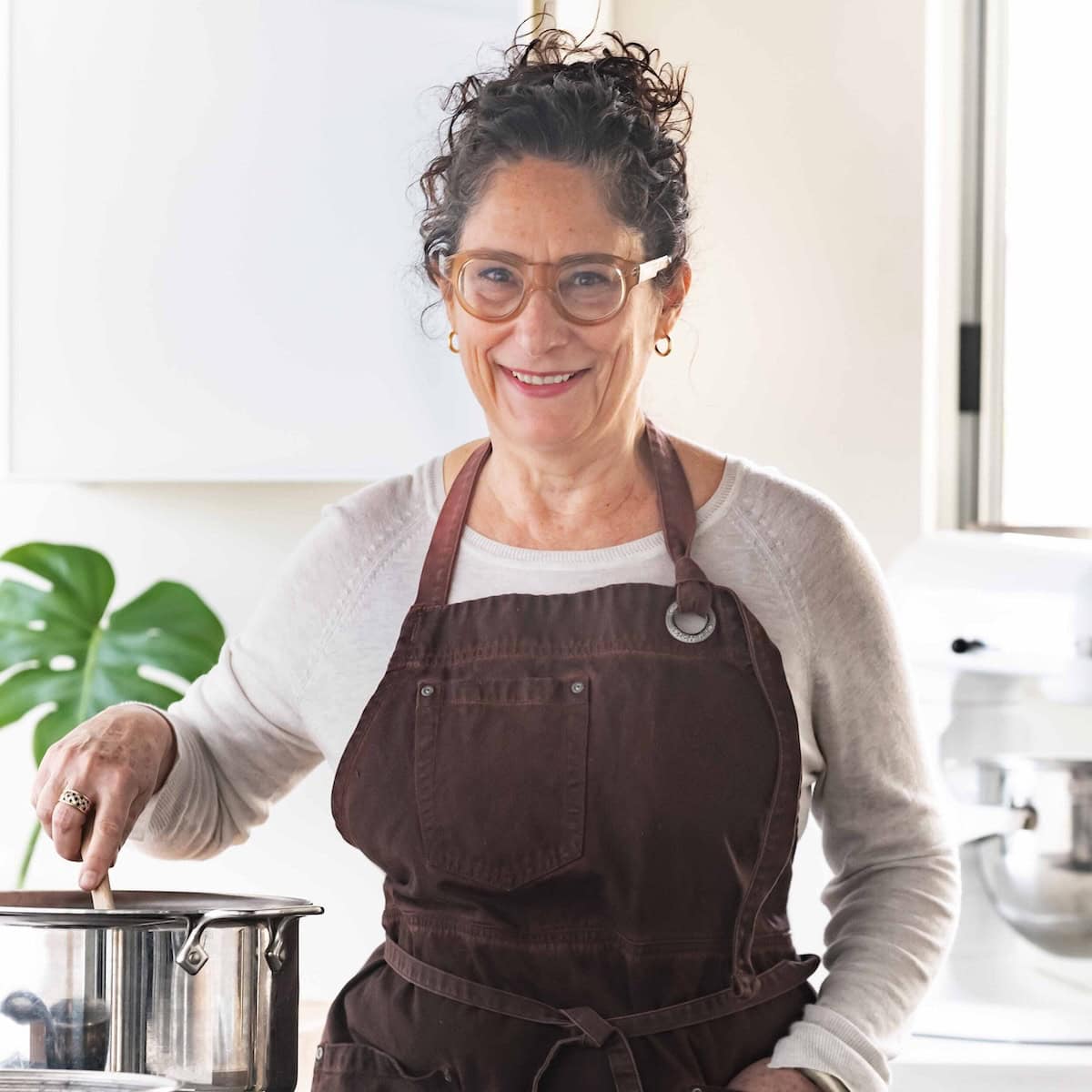
A: I’m a former journalist living in Dallas, Texas, juggling what has come to be known as a “portfolio career.” I’m a digital publisher, having founded my international cooking website, Cooks Without Borders, in 2016, and its companion Substack newsletter in 2023. My newsletter won a People’s Voice Webby Award earlier this year (in April 2024), just a year after it was launched.
Born and raised in Los Angeles, I went to college in northern California, lived in New York for 15 years as a young adult, then in 2001 returned to my home town, as a contributing editor for Travel + Leisure, and then as Food Editor at the L.A. Times. In 2009, my husband, son and I moved to Dallas, where I became restaurant critic and dining editor for the Dallas Morning News. During my New York years, I went to grad school at Columbia (MFA in fiction writing), then freelanced, met my husband, wrote six books and had a baby. Today, in addition to running Cooks Without Borders, I’m an entrepreneur with a busy restaurant consulting business. (My day job!)
My Cooks Without Borders Substack newsletter is probably my favorite part of my work life. It consists of weekly newsletters for paid subscribers and a monthly newsletter for free subscribers. The free posts (sent on or around the first of each month) tend to be seasonally focused, a look at what to cook in the coming month. The paid weekly post is much more insider-y, personal and deep-divey. I might write about a current cooking obsession, a cookbook I’m in the process of reviewing, a fascinating cooking trend, the surprising history of a dish, or something fun I’ve turned up in my travels.
One of the things paid subscribers have been finding valuable is that I’m taking no-holds-barred critical looks at cookbooks. As publishers and authors are evidently putting fewer resources into careful copyediting and testing, recipes containing errors or lack of clarity have become more and more commonplace — including in books by stars like Yotam Ottolenghi or Nancy Silverton. A faulty recipe can mean ruined dishes for home cooks, and few food writers are publishing thorough cookbook reviews that actually put recipes through their paces to call out such problems.
For my reviews, I typically test between six and eight recipes in a cookbook; the ingredients are expensive (as is the book, when I don’t receive a review copy); and all that testing is time-consuming. It’s the paid subscribers that allow me to do this kind of reader-service-focused work, and I appreciate them deeply for that. Without their support, I simply couldn’t afford to do it.
Q: Can you please describe the layout of your kitchen, how much of a role does it play with your family, and when writing for your ‘Cooks Without Borders’ newsletter?
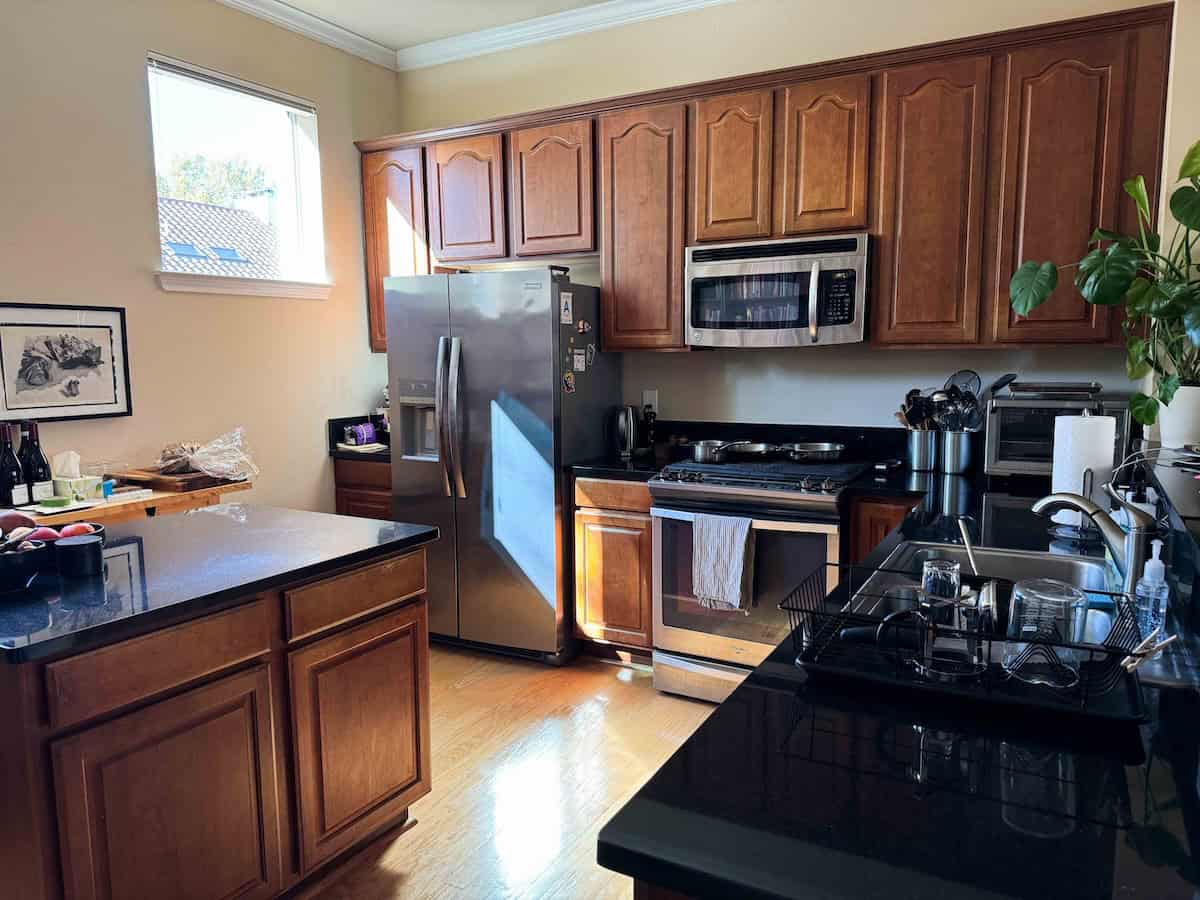
A: We live in a three-story townhouse with a pretty tight kitchen. When we downsized and moved to the city center in 2018, the one thing I said I wanted in a new home was a great kitchen. Instead we fell in love with a townhouse (on a beautiful walking trail in a super-walkable neighborhood) with a small, non-updated kitchen. It’s basically a square, with an island in the middle, the stove and fridge along one wall, cookbook shelves on the facing wall and a work counter on the windowed wall. The sink side has a view of the dining room — with a high counter for eating and looking into the kitchen.
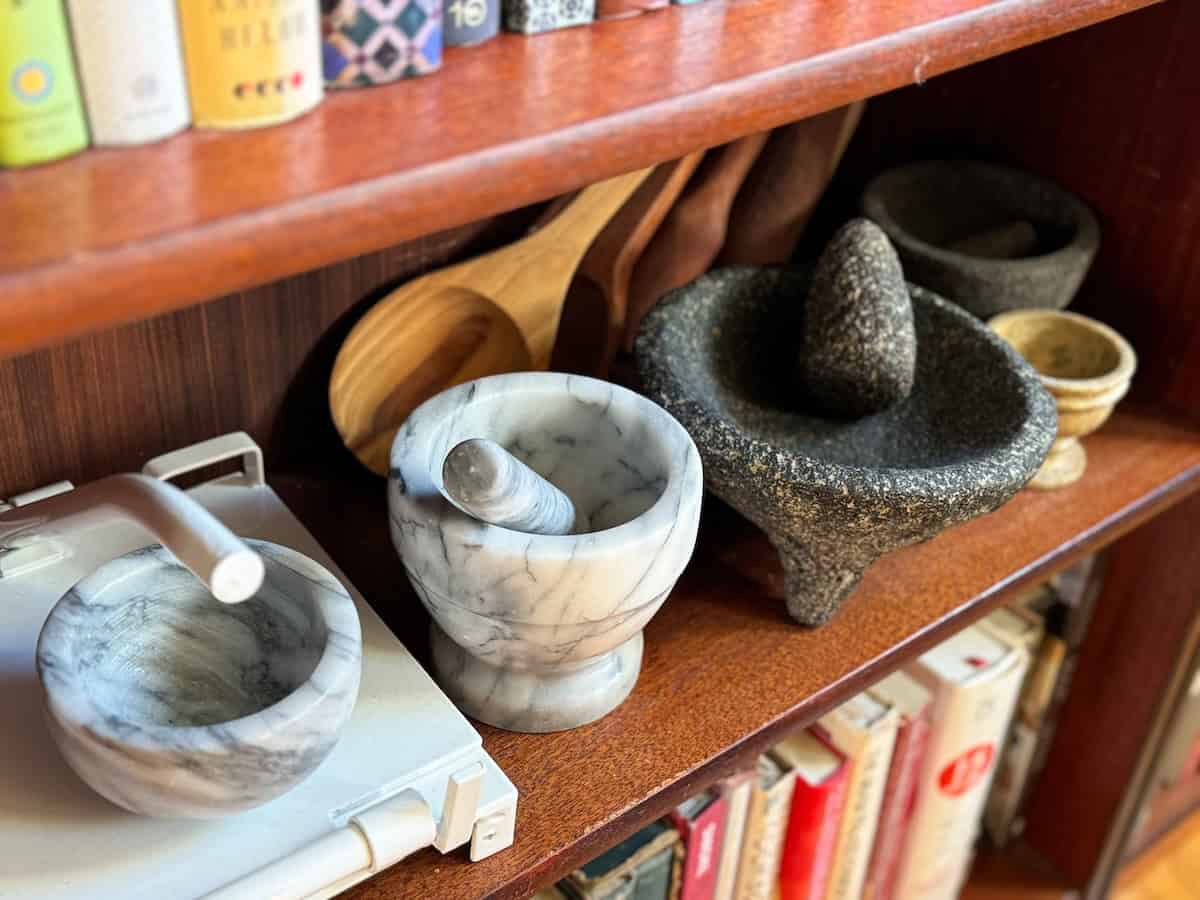
It may not be my dream kitchen, but it’s one of my happiest places — very workable, with ample counter space, and I love that cookbook wall (where I also stow some pretty serving pieces, Dutch ovens, mortars and pestles, etc.). When friends come for dinner, they have drinks and apps at the counter looking into it as I’m cooking. When our son Wylie is home with us (he’s away at graduate school in California), he spends a lot of time in our kitchen as well — often baking fabulous bread, something not in my wheelhouse. Our kitchen is the test kitchen for Cooks Without Borders, and my wall of cookbooks serves as the backdrop for lede cookbook review photos on the website.
Q: What are your most used kitchen gadgets and kitchen gear, that you cannot live without?
A: Oh, I’m attached to so many of them! Those mortars and pestles, as I grind a lot of spices; Doña Rosa tortilla press and Made In comal; a classic Atlas manual pasta machine; and a Fletcher’s Mill pepper grinder. Seems I favor old-fashioned mechanical tools. I’m a fan of Oxo’s replaceable-blade peelers, smooth-action garlic press and tiny measuring cups. You can find just about all of the tools I love in the Cooks Without Borders cookshop.
Q: Is there anything about your kitchen that you would like to change or improve on?
A: I’ve become very uncomfortable cooking with gas following revelations that using gas stoves (especially in poorly ventilated kitchens like mine) can have negative health consequences, such as causing asthma and cancer. We’ll probably switch to an induction stove (which will mean a lot of new cookware). In the meantime I sometimes use a fantastic countertop induction burner, I use my toaster oven when possible — though generally not for recipe testing. I think cooks should be taking the gas stove issue more seriously.
Q: What tips can you give us that will help keep our kitchens neat and tidy and easy to manage?
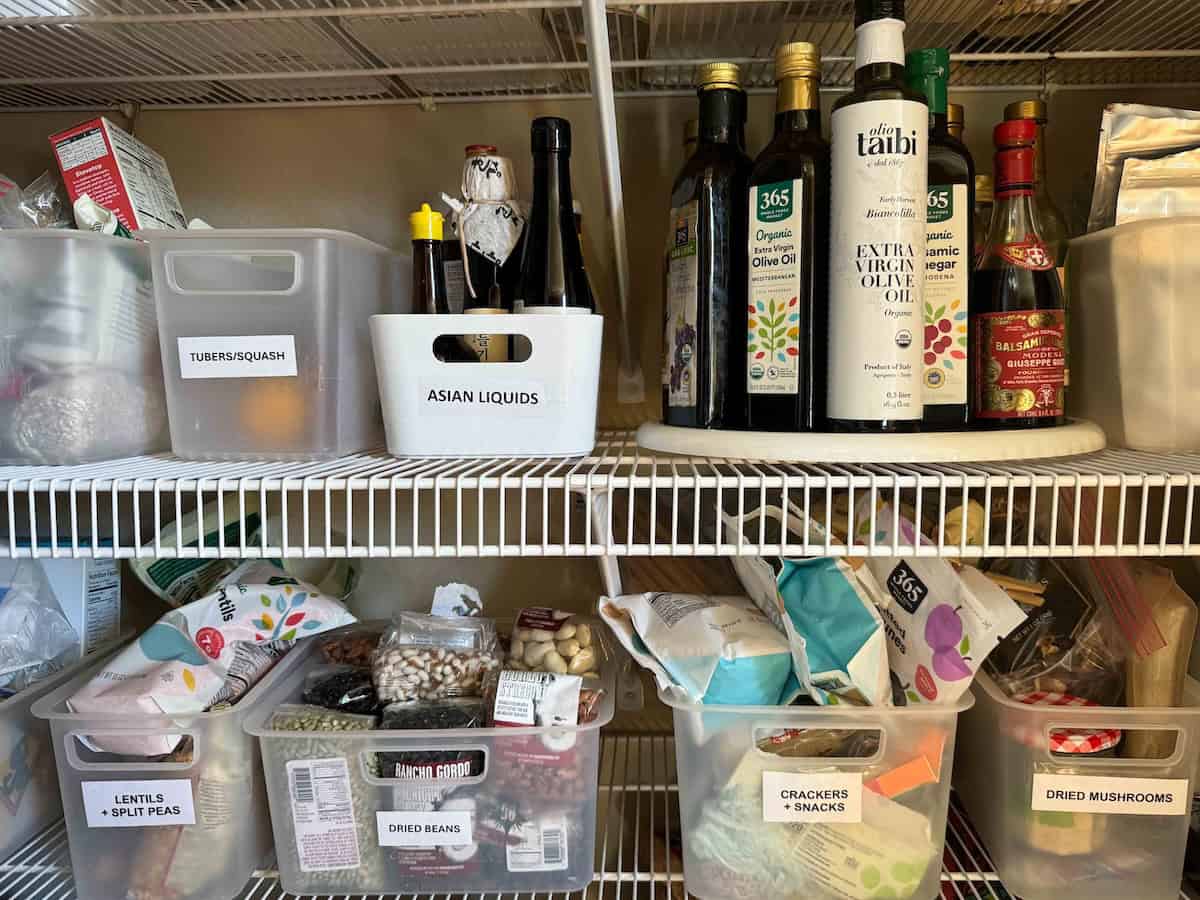
A: I have a shallow pantry with difficult-to-reach corners, so I’ve organized everything into labeled plastic bins. It’s easier to pull out a whole bin (of, say, spices, or grains, or legumes) and rummage through it than to find something way on the back of a shelf you can’t see well.
Q: You are a James Beard Award winning journalist. Can you please tell us about this and how you came to win the award twice?
A: The first award was in 1996, at the sixth James Beard Awards (it was founded in 1990, and the first awards were given in 1991). It was for a profile of Williams-Sonoma founder Chuck Williams I wrote for Avenue magazine. I just pulled it out and reread it for the first time in decades — it’s pretty interesting, as Williams (who died in 2015 at the age of 100) was responsible for the cooking equipment part of the sea change in American cooking in the mid-to-late 20th century. (The story can’t be found online. Perhaps I’ll republish it on my Substack.)
The second award was in 2004, for an article I wrote for the L.A. Times — “Forget What You Know: This Is Gazpacho.” (You may hit a paywall; you can also read about it here.)
Q: Your recipes are international. Which is your favourite cuisine to cook and why?
A: It depends on my current mood and what I’m obsessed with at the moment. Generally, I’m probably most fluent in French, Italian and Mexican cooking. French because I’ve been cooking it since high school – I was learning from Julia Child’s Mastering the Art in the 1970s. I’m married to a Frenchman, and have spent a ton of time cooking in France since we met in 1991. Mexican because I’ve dived so deeply into masa culture. I’ve been cooking Mexican for ages; when I moved to New York from California in 1986, I brought my molcajete, tortilla press and a supply of masa harina with me, because you couldn’t find them there in those days. And Italian because I’ve been soaking in that culinary culture for the last few years, as I’ve helped open an Italian restaurant in Dallas, and I’m now writing weekly newsletters for Eataly and hosting in-person events at Eataly Dallas.
But I also love exploring and learning about cuisines I know less well (Indian, Chinese, Thai, Peruvian, Vietnamese) and sharing what I’m learning with readers. Cooks Without Borders the website has a page where the cuisines are organized by culture, and I’m working on a Cuisine Guides program – also broken out by culture.
Q: How would you describe the regional cuisine where you live? Are there fresh food markets, or farmers markets available?
A: The regional cuisine in Texas is, of course, very interesting; the Michelin Guide has just come into the Texas market this year, and rewarded a whole bunch of barbecue restaurants with stars. (Because I don’t eat a lot of beef, I probably only eat barbecue about once a year.) I’m not a huge fan of Tex-Mex — which leaves an aftertaste of cultural appropriation — though I love its ancestor, Texas Mexican comida casera. And that masa movement has been strong here, so we can find excellent Mexican cooking in a few restaurants. Our growing season here in North Texas is very challenging, and the main farmers market in Dallas is an embarrassment — especially for someone who spent years shopping at L.A. and NYC’s exemplary farmers markets. We do have terrific Indian, Latin American and East Asian supermarkets with outstanding selections of fresh produce and pantry ingredients.
Q: How many cookbooks do you have and do you have any favourites? Can you tell us about the cookbooks you have written?
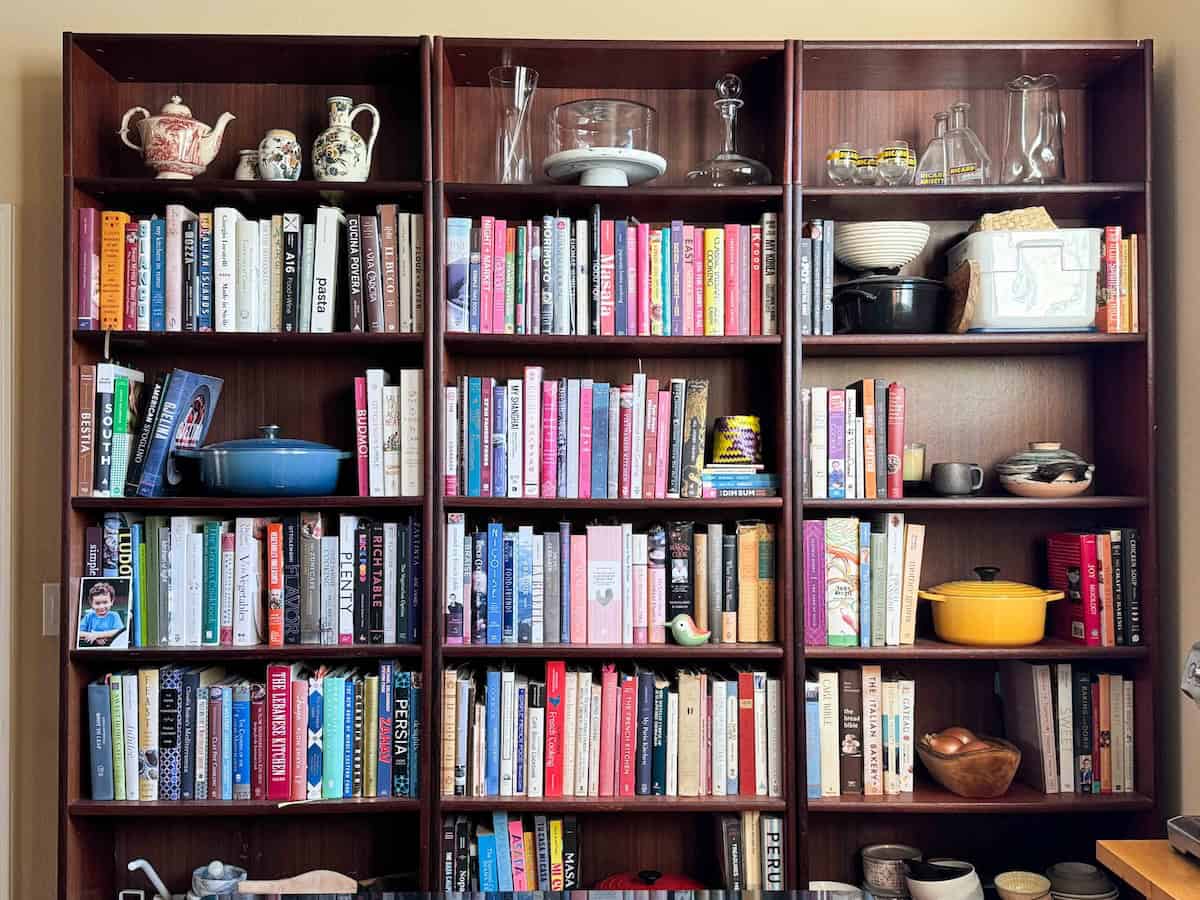
A: Oh, man, I have SO many cookbooks. The ones on my kitchen cookbook wall — 300-something, I think — are the ones I refer to most often; I have many more upstairs in my office and in the garage. I try to keep my collection pared-down; I’ve donated maybe 600 over the last 6 or 7 years to Texas Women’s University Library (which has a large collection), and also give cookbooks I no longer use to a friend who’s a chef.
The cookbooks I’ve written are Essential Flavors: The Simple Art of Cooking with Infused Oils, Flavored Vinegars, Essences and Elixirs (which I co-authored) and The Art of the Cocktail Party. Both were published in 1994. I’ve also published The Fourth Star: Dispatches from Inside Daniel Boulud’s Celebrated New York Restaurant (2002); American Appetite: The Coming of Age of a Cuisine (1999); and Fear of Wine: An Introductory Guide to the Grape (1995). I also wrote an acclaimed novel, Greetings from the Golden State. Alas, all of the above our out of print.
More recently, I’ve self-published an ebook: 21 Favorite Recipes from Cooks Without Borders. I usually have a promo going whereby I donate 100% of the proceeds to José Andrés’ World Central Kitchen. I’m currently putting the finishing touches on a second ebook, Fabulous French Recipes from Cooks Without Borders. Once it’s published, new and current paid subscribers to my Subtack will receive it as a perk. So if you’re thinking of treating yourself to a paid subscription, no need to wait!
Q: Do you have a favourite recipe that you would like to share with us?
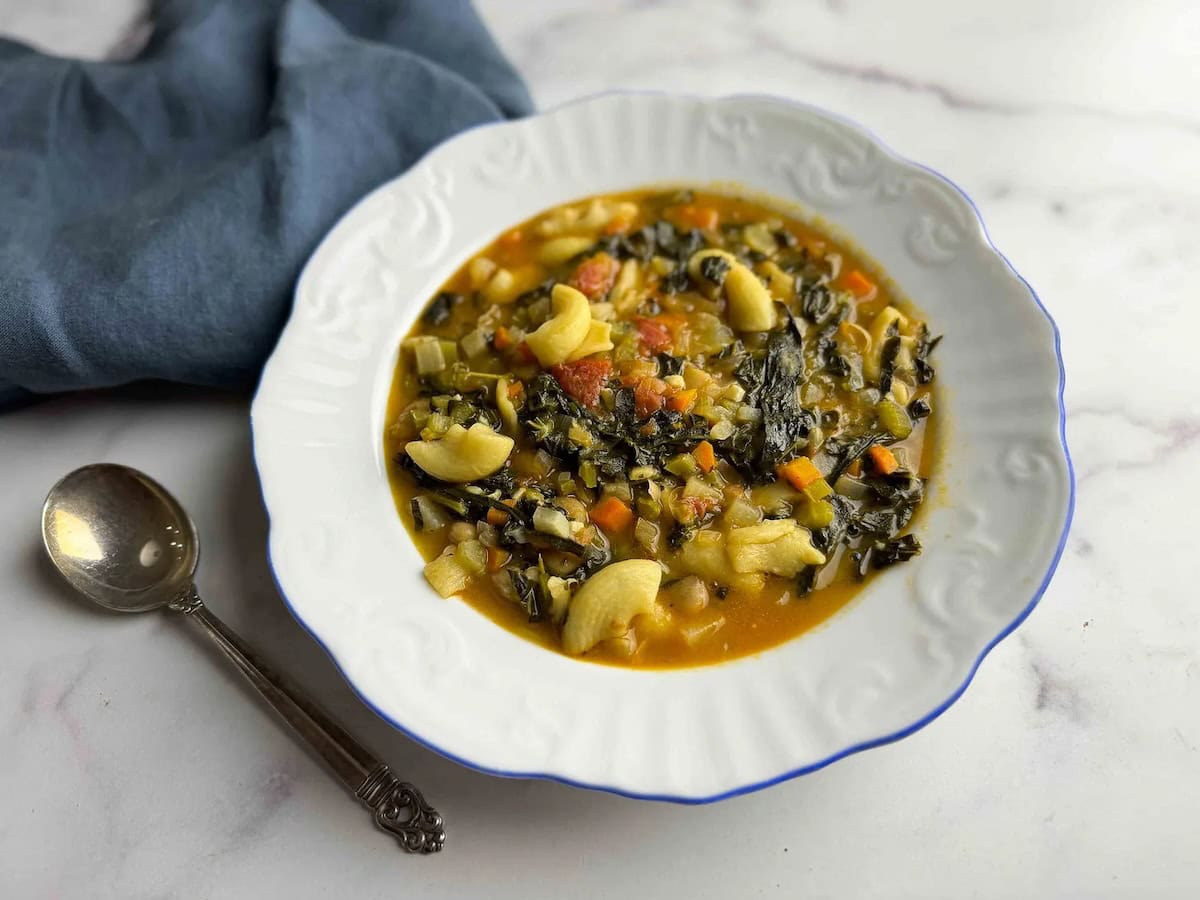
A: I don’t have one single favorite, but I do love this minestrone recipe I developed last winter.
Q: Have you had any kitchen disasters that you can share with us?
A: Baking was never my strength when I was a young cook; I’ve grown into it over the years. When I was in my late 20s, I made a flourless chocolate cake with a molten center for my then-sister-in-law, who was an excellent baker. We were celebrating her birthday at my mom’s house. It turned out beautifully – I was so proud and surprised! I dusted powdered sugar on top – too thickly – and wanted to lose some of it. I held the cake over the kitchen sink and blew on it gently to get rid of some of the sugar. Unfortunately, I wasn’t holding the cake quite level, and as I blew, the cake slid, sort of in slow-motion, into the sink and fell apart into a molten mess. I wish I had a photo of it — it was a complete cake-wreck! As for blowing on a cake, I was young – didn’t think about the germs.
Here’s a recipe for individually-sized versions of it.
Thank you for sharing your kitchen with us, Leslie. Visit and subscribe to ‘Cooks Without Borders’
Comments
Post a Comment